
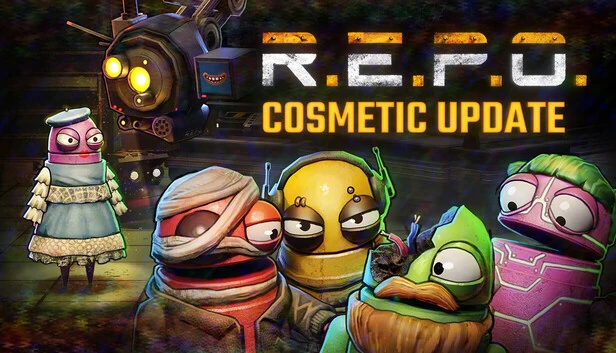
Gear and items · R.E.P.O. v0.4.0 · read from a local copy
Cosmetics and the token machine
The shop contains a machine that gives out player cosmetics.
R.E.P.O. gives out player cosmetics from their own machine in the shop: you spend currency, the machine spins a display, and a cosmetic token comes out at one of four grades.
What the game establishes
- The shop contains a machine that gives out player cosmetics. (checked against the game's own files)
- The build ships cosmetic textures of its own, including ones named for a banana and a bandana. (checked against the game's own files)
- The build names animations for its token, including one for a token being inserted. (checked against the game's own files)
- Cosmetics are handed over as tokens, and the game keeps tokens in four grades. (checked against the game's own files)
- The machine spins a display, settles on a result and celebrates it. (checked against the game's own files)
- A cosmetic is its own asset, laid over the avatar's base surfaces. (checked against the game's own files)
- The avatar is split into parts, so a cosmetic is applied to a part such as the head, the body, an arm or a leg. (checked against the game's own files)
- A cosmetic can be hidden again, and the game keeps its own interface for tokens and cosmetic objects. (checked against the game's own files)
- Bandages are an overlay of their own, named as a cosmetic among the layers the avatar wears. (checked against the game's own files)
- The cosmetic side ships icons of its own for clothing and for colour. (checked against the game's own files)
- The machine carries its own transform with a curve going in and a curve going out, text for its screen in plain and new versions with a localised asset, and debug settings for a cosmetic and its asset. (checked against the game's own files)
- The confetti the machine fires is built from parts: an active object, smoke gradients, fast lines, swirl lines and sparkles, each with their own gradients. (checked against the game's own files)
- A cosmetic object in the world carries a health display with a transform and a renderer, a rotation helper and a forward transform, a grab icon with colours for being inactive and active, and a button transform. (checked against the game's own files)
- The cosmetics include hats, among them a spiked mohawk hair piece and a spiked band. (checked against the game's own files)
- The machine's screen carries icons of its own, a money bag and a taxman, over a gradient background with scanlines across it. (checked against the game's own files)
- The plate the machine shows has its own animation in three parts, an intro, a loop and an outro, with an off state beside them. (checked against the game's own files)
- The machine's screen also names a background and a text background gradient. (checked against the game's own files)
In play
The shop has a machine for cosmetics, and it behaves like a dispenser rather than a shelf: you put currency in, the machine spins a display in front of you, and a cosmetic is handed over at the end.
What you receive is a token. The game keeps its tokens in four grades, and each grade has its own colouring, so an uncommon pull and a rare pull do not look the same even before you put either of them on.
The handover is staged rather than instant. The machine has its own animation and a confetti effect for the moment a cosmetic is revealed, and the reveal runs on a screen that spins up, then settles.
The celebration is built from parts as well. The confetti has an active object, a smoke gradient, fast lines and swirl lines with their own gradients, and sparkles and confetti with gradients of their own, which is why a pull can be marked without a single particle doing all of it.
Wearing a cosmetic is about the avatar rather than the whole character. The player figure is split into parts that each carry a default surface, and a cosmetic is laid over those surfaces, which is why a hat lands on the head instead of covering the body.
What is in the world has a state of its own. A cosmetic object carries a health display with a transform and a renderer, helpers for its rotation and its forward direction, a grab icon whose colour changes between inactive and active, and a transform for its button, which is how one can be picked up from the floor rather than only from a menu.
You are not stuck with what you pull. A cosmetic can be hidden again, and the game keeps a menu for your avatar as well as its own interface for the tokens and for cosmetic objects in the world.
The machine's own parts are recorded too. It has a transform for what it hands over, with a curve for the cosmetic arriving and another for it leaving, a screen with plain and new text and a localised asset behind that text, and debug settings that name a cosmetic and its asset, which is how the reveal can be looked at without spending anything.
What this entry does not tell you: what a spin costs, the odds of each grade, or how many cosmetics the game ships. We have not verified those numbers, so we do not print them.
Related
 Extraction and the shopThe shop between runsThe game has a shopkeeper and a shop manager for the between-run shop.
 Extraction and the shopHow upgrades are kept track ofAn upgrade is modelled as its own object with its own information.
Version and sources
A local copy of the game, read only. Identifiers are listed on the technical reference pages; nothing here is estimated. Documented build: 0.4.0.