
How the game behaves · R.E.P.O. v0.4.0 · read from a local copy
Hitting things with a vehicle
A vehicle carries a small, a medium and a big hurt collider.
Impacts in R.E.P.O. are measured rather than assumed: a vehicle carries three hurt colliders, impacts are graded small, medium and big from a threshold and a required distance, each grade costs durability of its own, and each shakes the camera and throws particles of its own size.
What the game establishes
- A vehicle carries a small, a medium and a big hurt collider. (checked against the game's own files)
- Impacts are detected over a window, with a cooldown and a cooldown per kind. (checked against the game's own files)
- Small, medium and big impacts each have a threshold and a required distance. (checked against the game's own files)
- Durability loss is scaled by a multiplier with a separate amount for each size of impact. (checked against the game's own files)
- Each size of impact has its own durability cooldown for enemies. (checked against the game's own files)
- There is an enemy impact box transform and a bumper car box. (checked against the game's own files)
- Impacts shake the camera with position and rotation strengths, a decay rate and an intensity for each size. (checked against the game's own files)
- Each grade of impact has its own particles, and there are transforms for the midpoint and the impact point. (checked against the game's own files)
- Durability loss against monsters is graded three ways by level: small, medium and big impacts each have three of their own. (checked against the game's own files)
In play
Driving into something is not a single event. A vehicle is built to detect a collision, decide how big it was and then pay for it, which is why a light nudge and a full-speed crash do different things.
It has three hurt colliders. There is a small, a medium and a big one, so what the vehicle can hit is set up in sizes rather than as one shape.
It watches for impacts over a window. There is a detection window, a cooldown after an impact and a further cooldown for each kind, which is why a scrape cannot be counted as a dozen separate crashes.
An impact is graded from a threshold and a distance. Small, medium and big impacts each have a threshold to cross and a distance the object has to be away for that grade, so brushing past and ploughing into something are told apart.
Durability is paid by grade. There is a multiplier for the loss and a separate amount for a small, a medium and a big impact, which is how a vehicle wears out differently depending on how it is driven.
Hitting a monster is handled apart. Each size of impact has its own durability cooldown for enemies, so a run of hits on a creature does not drain the vehicle as fast as the same hits on scenery.
What a hit costs a monster is graded again. For each size of impact there are three levels of durability loss, so a small hit, a medium hit and a big one each have their own figures to work from rather than one number shared out.
It has a box for enemies and one for bumper cars. There is an enemy impact box transform and a bumper car box, which is why the same vehicle can register a hit on a creature differently from a hit on a fairground car.
The camera takes the hit as well. There are shake strengths for position and rotation with a decay rate, and an intensity for each size of impact, so what you feel matches what you hit.
It also throws sparks of the right size. Each grade has its own impact particles, and there are transforms for the midpoint of the vehicle and for the point of impact, so the effect happens where the collision did rather than at the middle of the model.
What this entry does not tell you: how much durability a vehicle has, how much each grade costs, or how hard you must hit to reach the biggest one. We have not verified those numbers, so we do not print them.
Related
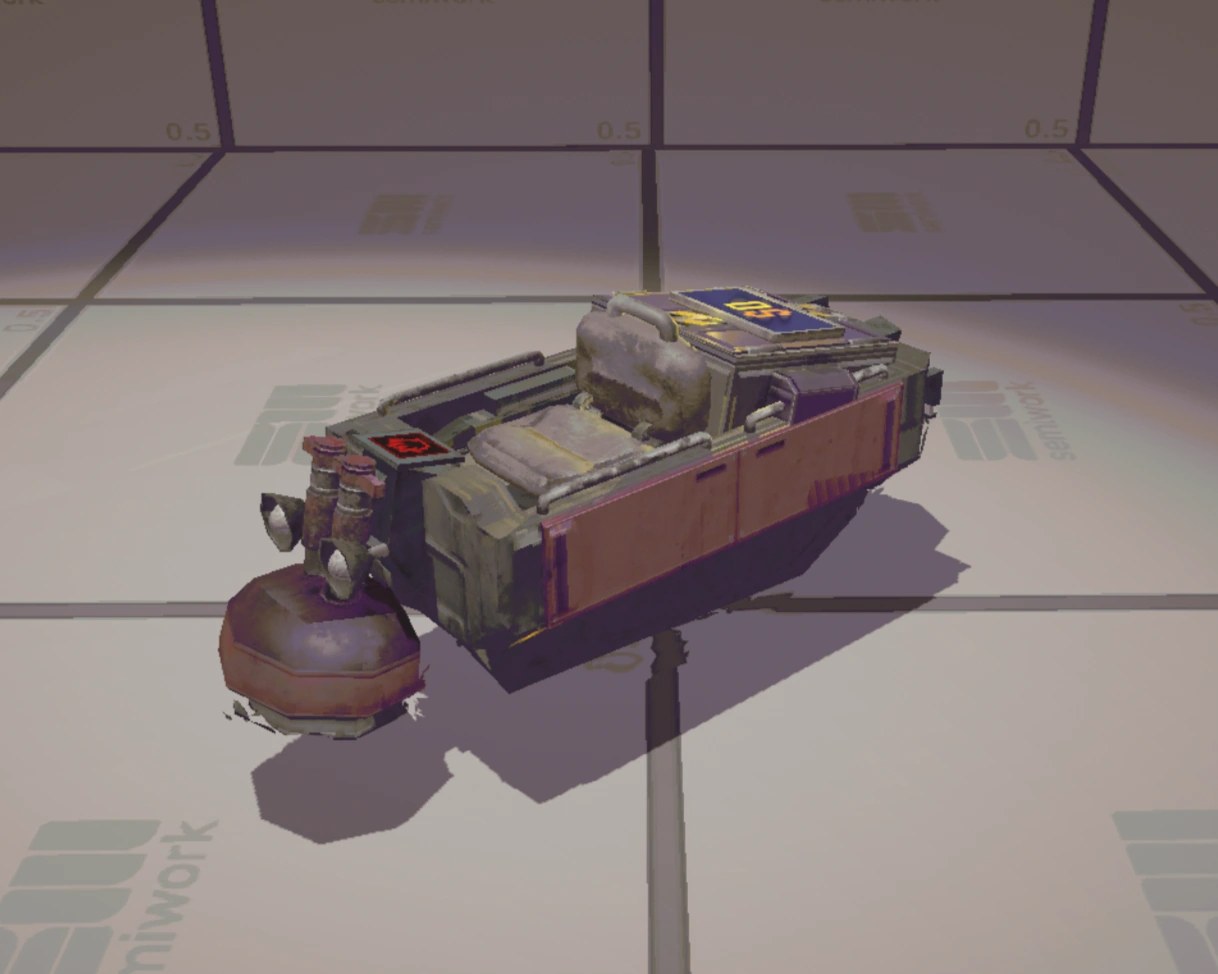 How the game behavesDriving a vehicle and staying uprightA vehicle is an item with a state and a timer of its own.
 How the game behavesLeaving the ground in a vehicleBeing airborne is a system with its own switch and a lift force.
 How the game behavesThe sparks a vehicle throwsSparks come as a left set and a right set, each with a transform of its own.
 How the game behavesA vehicle that is wrecked, and the box on itA vehicle being destroyed runs through states rather than being one event.
Version and sources
A local copy of the game, read only. The grounding for each fact is listed on the technical reference pages; nothing here is estimated. Documented build: 0.4.0.