
How the game behaves · R.E.P.O. v0.4.0 · read from a local copy
How a vehicle's body follows its physics
A mesh transform follows the physics with its own position and rotation smoothing.
The body you see on a vehicle in R.E.P.O. is not the thing being simulated: a mesh transform follows the physics with its own smoothing, it can be pushed forward and tilted, it dismounts at a speed and teleports at a distance, it wobbles on a spring when hit, and other players' vehicles are predicted rather than received.
What the game establishes
- A mesh transform follows the physics with its own position and rotation smoothing. (checked against the game's own files)
- The body can be pushed forward and tilted, with a distance and smoothing time for the tilt and separate offsets for looking up and down. (checked against the game's own files)
- There is a speed at which the body dismounts and a distance at which it teleports. (checked against the game's own files)
- The wobble has minimum velocity and deceleration, a maximum deceleration and a cooldown. (checked against the game's own files)
- Its position and rotation strengths have maxima, and it is driven by a spring with a stiffness and a damping. (checked against the game's own files)
- Other players' vehicles can be predicted with a lookahead, a smoothing time and maximum position and rotation offsets. (checked against the game's own files)
- The prediction snaps at a distance and an angle, applies above a minimum speed, and smooths velocity over its own time. (checked against the game's own files)
In play
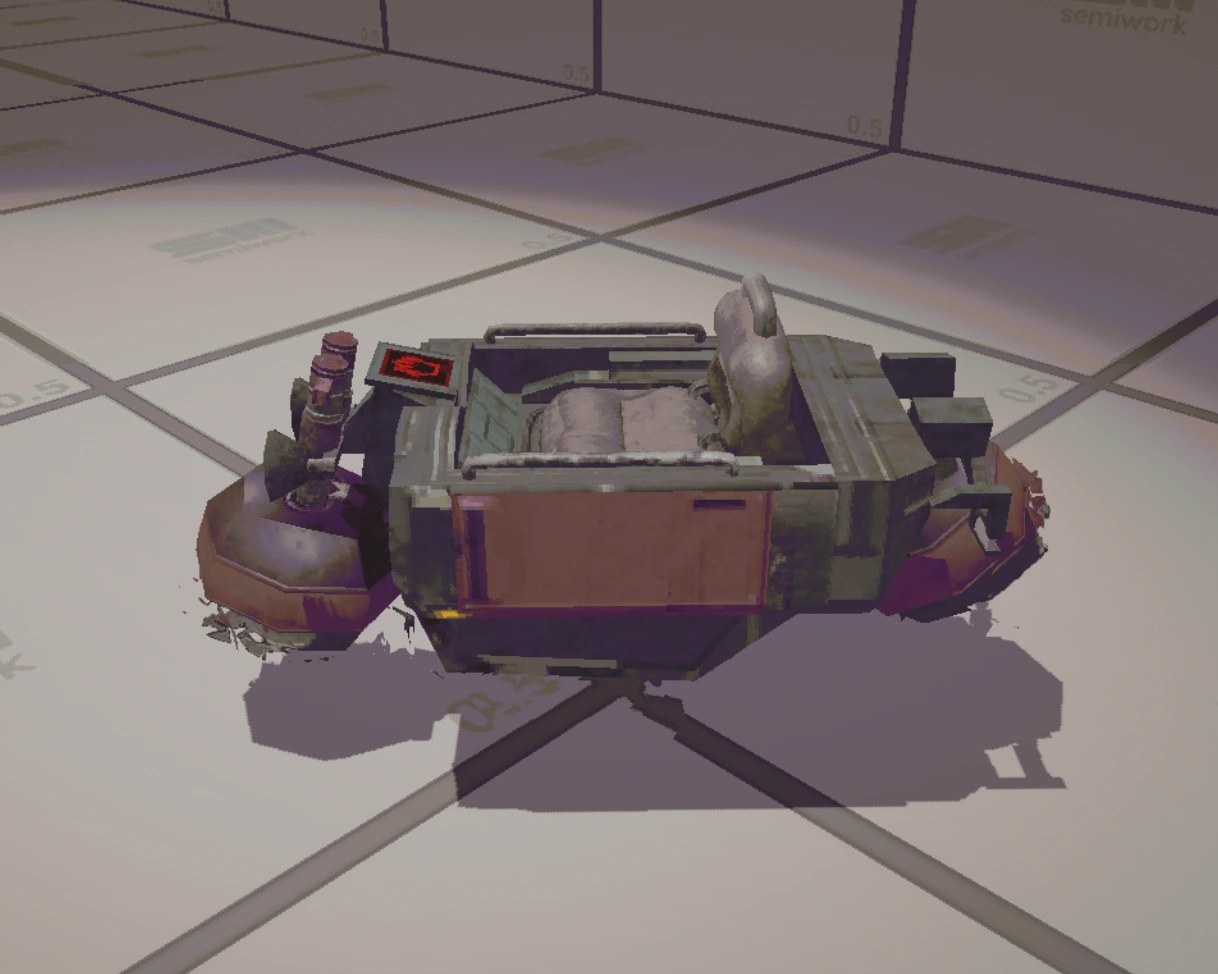
What you look at is not what is being pushed around. The physics object and the body are separate, and a mesh transform follows the physics with smoothing of its own, which is why the drawn vehicle can lag, settle and lean without changing how it handles.
The follow is smoothed in two ways. There is a smoothing time for the position and a separate one for rotation on one axis, so the body can be steadier or looser than the simulation behind it.
It can be pushed forward as it goes. There is a maximum forward offset for the body, along with a distance and a smoothing time for a tilt push, so a vehicle can lean into its own movement rather than staying rigid.
Looking up and down changes it too. There are separate forward and downward offsets for when the body is tilted upwards, which is how a vehicle can nose up visually while its physics does the real work.
It dismounts and it teleports. There is a speed at which the body comes off and a distance at which it gives up following and snaps, so a gap between the drawn body and the simulation is bounded rather than left open.
A hit makes it wobble. The wobble has a minimum velocity and a minimum deceleration before it triggers, a maximum deceleration, a cooldown, position and rotation strengths with maxima of their own, and a spring stiffness and damping behind it, which is why a knock is felt in the body and not only in the handling.
Other players' vehicles are predicted. Their bodies are advanced with a lookahead and smoothed over a time, with maximum position and rotation offsets, a distance and an angle at which they snap instead, a minimum speed before prediction applies and a smoothing time for their velocity.
That prediction can be switched off, and it is deliberately bounded: it will only stretch so far before snapping to where the vehicle actually is, which is what keeps a predicted car from drifting through a wall on your screen.
What this entry does not tell you: how far the body may lag, how long a wobble lasts, or how far ahead a prediction runs. We have not verified those numbers, so we do not print them.
Related
 How the game behavesDriving a vehicle and staying uprightA vehicle is an item with a state and a timer of its own.
 How the game behavesHitting things with a vehicleA vehicle carries a small, a medium and a big hurt collider.
Version and sources
A local copy of the game, read only. The grounding for each fact is listed on the technical reference pages; nothing here is estimated. Documented build: 0.4.0.