
Monsters · R.E.P.O. v0.4.0 · read from a local copy
The floater and how it attacks
The floater has a controller and an animator of its own rather than sharing another monster's.
The floater is a monster of its own rather than a variation of another: its head, arms and legs are driven by springs, its attack runs through named states with their own sounds, and it dies into particles of its own.
What the game establishes
- The floater has a controller and an animator of its own rather than sharing another monster's. (checked against the game's own files)
- Its head, both legs and both arms each have a spring with a target and a source. (checked against the game's own files)
- The animator carries multipliers for how fast the springs settle and how much they damp. (checked against the game's own files)
- The attack runs through named states with a timer beside the current one. (checked against the game's own files)
- The attack has separate sounds for charging, for the delay before the hit and for the strike going up and coming down. (checked against the game's own files)
- There are separate sounds for being hurt, for dying and for being stunned, and a loop that plays while stunned. (checked against the game's own files)
- Dying uses four separate particle systems rather than one shared effect. (checked against the game's own files)
- The area effect the attack leaves behind has states of its own. (checked against the game's own files)
- Each spring keeps a source and a target of its own for the head, both legs and both arms. (checked against the game's own files)
- The delay before the hit and the strike going up and coming down also have versions played for everyone rather than only nearby. (checked against the game's own files)
- There is an attack logic object, and loops for the charge and the delay each carry a flag for whether they are playing. (checked against the game's own files)
In play
The floater is a monster in its own right rather than a variation of something else. The game gives it a controller and an animator of its own, with a set of states that belong to it.
Its body is driven by springs. The head, both legs and both arms each have a spring with a target and a source, and the animator carries multipliers for how fast those springs settle and how much they damp, which is why the floater moves as a loose bundle rather than as a rigid shape.
Its attack is a sequence. The game runs the floater's attack through named states and keeps a timer beside the current one, so charging, waiting and striking are read in order rather than being a single animation.
The sequence can be heard. There are sounds for starting the charge, for the delay before the hit, for the strike going up and for it coming down, with loops for both the charge and the delay, which is why you can hear that something is coming before it arrives.
It is not silent when it is stopped either. There are separate sounds for being hurt, for dying and for being stunned, and a loop that plays while it is stunned.
Dying is an effect of its own. Impact, pieces thrown far, shorter pieces and smoke are four separate particle systems rather than one shared explosion.
Every spring has two ends. The head, both legs and both arms each keep a source and a target, so the body is pulled between fixed points rather than being posed joint by joint.
The attack is run by an object of its own and can be heard further than it can be seen. The delay before the hit and the strike going up and coming down have versions played for everyone, and the charge and the delay each have a loop with a flag saying whether that loop is playing.
The area effect the attack leaves behind has states of its own, so what the attack does across a space is tracked rather than being a single hit.
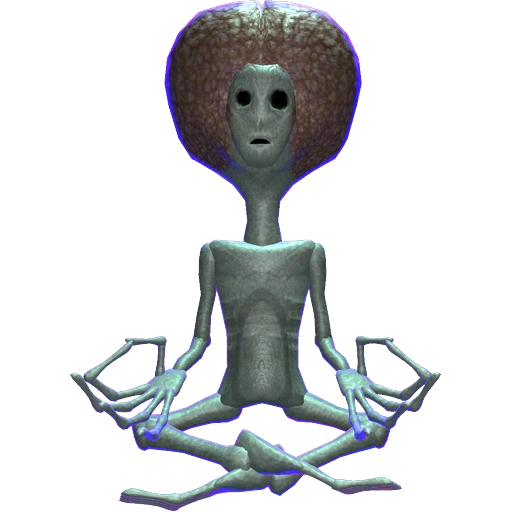
The image beside this entry is the game's own: the colour texture of the floater.
What this entry does not tell you: how much damage a floater does, how long its charge lasts, or how many of them a level may hold. We have not verified those numbers, so we do not print them.
Related
 MonstersEnemies and what they doThe game defines several distinct monsters rather than one enemy type.
 MonstersEnemies that move differentlyAt least one monster moves by tumbling rather than walking.
Version and sources
A local copy of the game, read only. The grounding for each fact is listed on the technical reference pages; nothing here is estimated. Documented build: 0.4.0.